
A jib crane is a lifting device that handles loads within a fixed working radius, using a horizontal arm (the boom or jib) mounted on a vertical post, wall bracket or column.
A hoist and trolley run along the boom, allowing the load to be lifted, lowered and moved horizontally. Because the boom is fixed to a rotating mount, the whole assembly can swing through an arc, typically 180 to 360 degrees depending on the configuration. This design gives the crane coverage which spans a defined circular area rather than a full room or building.
Jib cranes are typically used in manufacturing, engineering and warehouse settings for repetitive, localised lifting, such as loading parts onto machinery, handling materials at a single workstation or positioning loads during unloading. They’re a lower-cost, lower-footprint alternative to a full overhead crane system when the lifting requirement is confined to one area rather than spread across a facility.
If you are looking to purchase a jib crane for your operations, the Metreel team can help you further when you get in touch.
For now, this post will run you through what a jib crane is and when you would purchase one over another type of crane.
How Do Jib Cranes Work?

A jib crane works through three coordinated motions. Rotation swings the boom around the mast or wall mount, covering the crane’s working arc. Transverse motion moves the trolley and hoist along the length of the boom, positioning the load horizontally. Lift motion raises and lowers the load vertically via the hoist.
On manual units, these motions are driven by a winch, chain hoist or pulley system operated by hand. Powered units use motorised controls to handle rotation, trolley movement and lifting, often via a pendant or wireless control. Between the three motions, the crane can pick up a load, swing it through its arc and set it down precisely within its working radius.
As we’ve just touched upon, a jib crane has 3 main motions that you’re likely to utilise during its use. Let’s look at these in further detail:
Rotational motion – this is essentially the way in which the boom will spin around the pillar/mount.
Transverse motion – this is the movement of the hoist along the boom (horizontally)
Lift motion – this refers to the movement of goods or materials vertically (up and down)
If your jib crane is manually operated you’ll find that the lift motion (and sometimes the transverse motion) is done using a winch, hoist or pulley system, more often than not using a chain. However, if you opt for a powered jib crane, you can simply use the included controls to activate the movements mechanically.
Key Components of a Jib Crane
Understanding the main parts of a jib crane helps when specifying the right system for your facility.
Boom: The horizontal arm that extends from the mast or wall bracket. The hoist and trolley travel along the boom, allowing loads to be moved in and out within the crane’s working radius.
Mast: The vertical support structure that the boom attaches to. On floor-mounted systems, the mast is anchored directly to the facility floor. On wall-mounted systems, it is secured to an existing structural wall or column.
Trolley: Runs along the length of the boom, carrying the hoist and allowing horizontal (transverse) movement of the load.
Hoist: The lifting device that raises and lowers the load. Hoists can be manual, electric or pneumatic depending on the application.
Rotation mechanism: Allows the boom to swing around the mast through a defined arc. Depending on the crane type and mounting position, rotation ranges from 180 degrees to a full 360 degrees.
Rotation stop: Limits the swing of the boom where an obstruction such as a wall or column is present, preventing collision.
Collector rings: Fitted to the top or bottom of the mast on powered jib systems, these allow continuous 360-degree rotation without cable tangling.
Types of Jib Crane
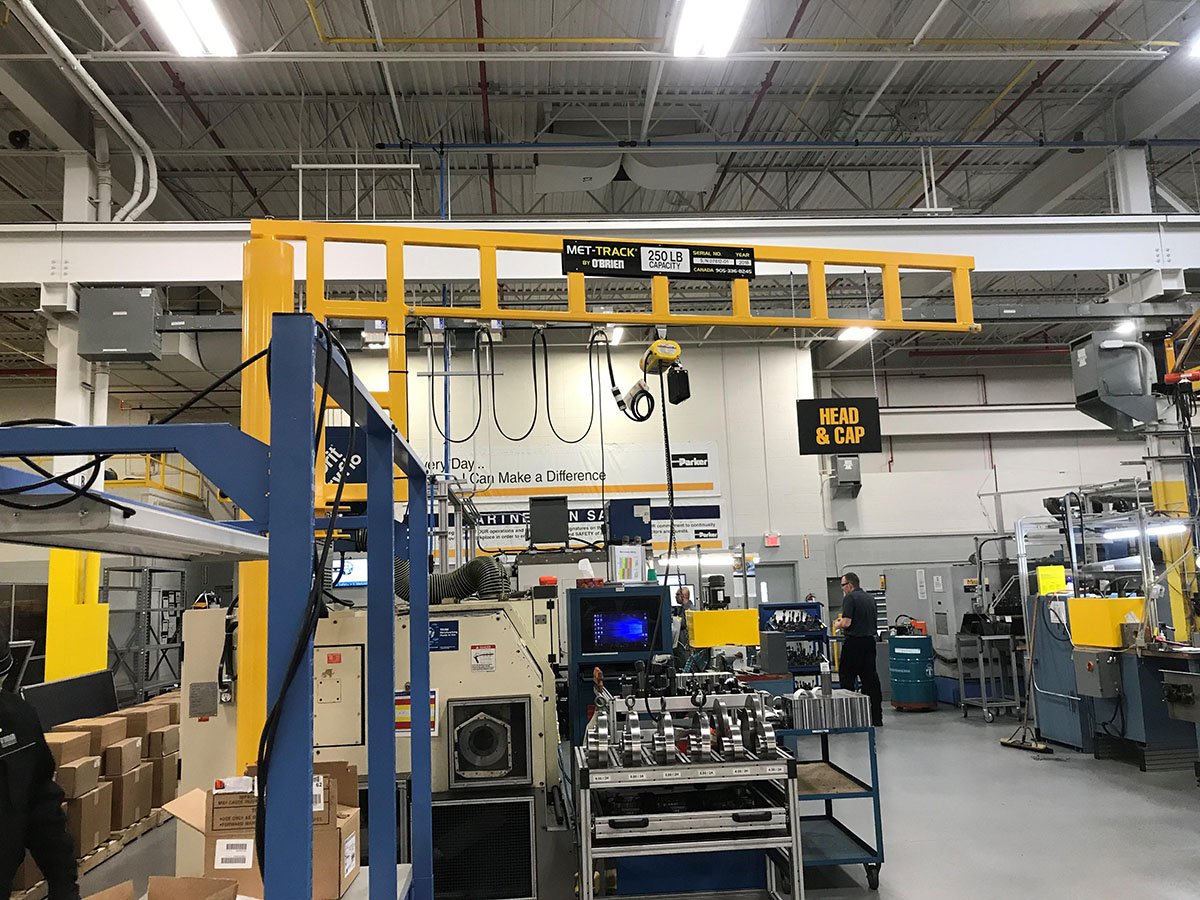
Jib cranes can be used both inside and outside which means that this type of lifting equipment is a worthwhile addition to any industrial environment. There are many different styles and types of jib crane which means that no matter the use case, you’ll find them to be suited to the task at hand, whether that’s a compact wall-mounted unit for a maintenance bay or a heavy duty floor-mounted system for a busy production line.
Floor Mounted Jib
The most common configuration. The mast is anchored directly to the facility floor, providing a freestanding lifting station that does not rely on existing building structure. Floor-mounted jib cranes typically offer rotation of up to 270 degrees, with full 360-degree rotation achievable on certain designs. This makes them well suited to workstations where loads need to be repositioned across a wide arc.
Because they require a secure foundation, floor-mounted jib cranes are a more permanent installation. They can be positioned independently of walls and columns, giving flexibility in facility layout.
Wall-Mounted Jib
Where floor space needs to remain clear, a wall-mounted jib crane attaches to an existing structural wall or column. Rotation is typically between 180 and 200 degrees depending on the mounting position and surrounding obstructions. Wall-mounted systems are a practical choice for maintenance bays, assembly lines and fabrication shops where the lifting zone is concentrated along one side of a workspace.
Over-Braced Jib
You’ll see that an over-braced jib crane has a support brace that helps to add structural support to the boom/track. This brace is situated over the top of the track and will share the stress and load of the items you’re lifting. This not only makes the crane stronger but will also help to increase durability.
Under-Braced Jib
The under-braced variant positions the support brace beneath the boom rather than above it. This configuration is better suited to low headroom environments where an over-braced design would reduce available lifting height. Performance is broadly comparable to the over-braced configuration, with the primary difference being suitability for restricted vertical clearance.
Where are Jib Cranes Used?
Jib cranes are used across a wide range of industrial and commercial environments, including:
- Manufacturing and assembly – for lifting components onto machinery or assembly fixtures at individual workstations
- Engineering workshops – for handling tooling, moulds and fabricated parts within a machining bay
- Loading docks and warehouses – for positioning loads during unloading or staging operations
- Maintenance areas – for lifting equipment for inspection, repair or replacement without disrupting the wider facility
- Production lines – for managing high-frequency, repetitive lifts where ergonomic handling reduces operator fatigue and injury risk
HSE data indicates that manual handling accounts for over 20% of non-fatal workplace injuries in manufacturing and warehousing. Jib cranes reduce reliance on manual lifting by providing a controlled, mechanical means of repositioning loads within a workstation.
Jib Crane UK FAQs
Buying a jib crane can unlock endless potential for your operations. But as a considered purchase, we know you might have lots of questions about jib cranes and how they work.
If you don’t see your question below, please reach out to our team for advice.
What Is A Jib Crane?
A jib crane is a lifting device that handles loads within a fixed working radius, using a horizontal arm (the boom or jib) mounted on a mast, wall bracket or column. A hoist and trolley run along the boom, lifting and moving loads horizontally, while the whole assembly rotates through an arc of 180 to 360 degrees. It’s commonly used in manufacturing and warehouse settings as a compact, lower-cost alternative to a full overhead crane.
What Is The Purpose of a Jib Crane?
A jib crane provides controlled, repeatable lifting within a single workstation or bay, cutting reliance on manual handling. It suits tasks concentrated in one area, such as loading parts onto machinery or handling materials at a loading dock, rather than moving loads across a whole facility. It’s simpler and cheaper to install than an overhead gantry system, making it a practical choice where lifting needs are localised rather than facility-wide.
Why Do They Call It a Jib Crane?
The name comes from “jib”, an engineering term for a projecting, pivoting arm. It originates from sailing, where a jib is a triangular sail rigged to a boom that swings as the vessel turns. Crane design adopted the term for the horizontal boom that extends from the mast and rotates through an arc, since that pivoting arm is the defining feature of this crane type.
What Are The Disadvantages of A Jib Crane?
The main drawback is limited reach, since a jib crane only covers the circular area within its boom’s radius, unlike an overhead crane that spans a whole facility. Floor-mounted versions need a permanent foundation, reducing layout flexibility. Wall-mounted versions have reduced rotation, typically 180 to 200 degrees, due to the wall. Load capacity is also generally lower than a full overhead system.
However, as with all crane types, it’s not really the case that any type has ‘drawbacks’. Rather, the key is to specify the right crane type for your needs. A jib crane is designed to offer controlled lifting within a fixed area to reduce the need for manual handling. So long as a jib crane is correctly specified, it will meet all of your requirements for improving safety and productivity in your workplace.
Discuss Your Jib Crane Requirements With Metreel
Metreel has been supplying and installing mechanical handling equipment across the UK for over 40 years.
Our jib crane range covers floor-mounted, wall-mounted, over-braced and under-braced configurations, with bespoke solutions available where standard designs do not meet your requirements. All systems are supplied and installed by our LEEA-accredited team and supported by full documentation for LOLER compliance.
If you’re in need of a jib crane, or you’d like to know more about how we could help you, get in touch with us on 0115 932 7010 or email us at [email protected].